

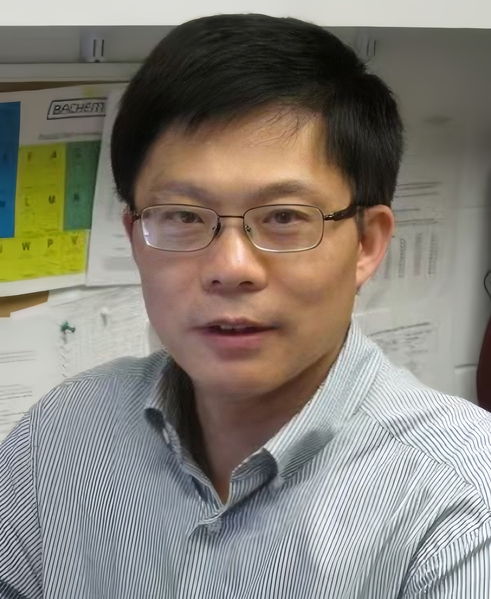
Dr. Wang’s research interest lies in the interface of chemistry and biology. The goal of his research is to develop innovative, practically useful chemical tools for the study of chemistry, biology and medicine. His invented organocatalysts chiral pyrrolidine sulfonamides and chiral bifunctional binaphthyl amine thioureas have been commercialized by the Aldrich. He formulated the natural product-based ‘privileged’ structure-directed organocatalytic cascade strategy and discovered a drug candidate, which has been licensed to the Novo Nordisk in clinical trials as a new class therapy for substance abuse treatment. The ‘oxidative enamine catalysis’ as a new activation mode in aminocatalysis was highlighted in Chemical & Engineering News as the “News of the Week”. He conceptualized “the analyte regeneration fluorescent probes” design strategy for the sensor development and targeted protein degradation SenoTAC strategy for fighting aging related diseases. He introduced a novel synthetic biology strategy enabling conditional control of molecular glue activities to spatiotemporally manipulate (sub)cellular functions and induce desired biological or therapeutic effects for precision medicine. In the recent efforts, Dr. Wang has developed dual functional bioorthogonal tetrazine reagents for efficient protein engineering, labeling, and drug discovery and delivery.
BACKGROUND INFORMATION
Prior to joining EIT, Dr. Wei Wang was a Coit Professor in the R. Ken Coit College of Pharmacy and Co-Director of the Arizona Center for Drug Discovery at the University of Arizona, USA. Dr. Wang received his BS in chemistry from Nanjing Normal University in 1988, MS in organic chemistry from Shanghai Institute of Materia Medica, Chinese Academy of Sciences in 1993, and PhD in organic chemistry from North Carolina State University in 2000. He completed postdoctoral training in medicinal/peptide chemistry at the University of Arizona (2000-2001). Dr. Wang was senior PI in medicinal chemistry in the Genomics Institute of the Novartis Research Foundation in San Diego (2001-2003), then tenure-track Assistant Professor (2003-2008), Associate Professor with tenure (2008-2012) and Full Professor (2012-2018) in the Department of Chemistry and Chemical Biology at the University of New Mexico in Albuquerque. Dr. Wang is the Fellow of the American Institute for Medical and Biological Engineering and the recipients of University of Arizona Cancer Center Research Prize for Basic Science, University of Arizona (2023), the James Halpert Award for research excellence, R. Ken Coit College of Pharmacy, University of Arizona (2021), the Michael J Fox Foundation Rapid Response Innovation Award (2013), and The Chinese-American Chemistry & Chemical Biology Professors Association (CAPA) Distinguished Junior Faculty Award (2008).
RESEARCH FIELD
Dr. Wang’s research interest lies in the interface of chemistry and biology. The goal of his research is to develop innovative, practically useful chemical tools for the study of chemistry, biology and medicine. His invented organocatalysts chiral pyrrolidine sulfonamides and chiral bifunctional binaphthyl amine thioureas have been commercialized by the Aldrich. He formulated the natural product-based ‘privileged’ structure-directed organocatalytic cascade strategy and discovered a drug candidate, which has been licensed to the Novo Nordisk in clinical trials as a new class therapy for substance abuse treatment. The ‘oxidative enamine catalysis’ as a new activation mode in aminocatalysis was highlighted in Chemical & Engineering News as the “News of the Week”. He conceptualized “the analyte regeneration fluorescent probes” design strategy for the sensor development and targeted protein degradation SenoTAC strategy for fighting aging related diseases. He introduced a novel synthetic biology strategy enabling conditional control of molecular glue activities to spatiotemporally manipulate (sub)cellular functions and induce desired biological or therapeutic effects for precision medicine. In the recent efforts, Dr. Wang has developed dual functional bioorthogonal tetrazine reagents for efficient protein engineering, labeling, and drug discovery and delivery.
EDUCATIONAL BACKGROUND
1996-2000: PhD (major in organic chemistry), Department of Chemistry, North Carolina State University
1990-1993: MS (major in organic chemistry), Shanghai Institute of Materia Medica, Chinese Academy of Sciences
1984-1988: BS (major in chemistry), Nanjing Normal University
WORK EXPERIENCE
2025-present: Chair Professor, Department of Chemistry of Eastern Institute of Technology
2018-2025: R. Ken Coit Professor, Department of Pharmacology and Toxicology of University of Arizona
2012-2018: Professor, Department of Chemistry and Chemical Biology of the University of New Mexico
2008-2012: Associate Professor, Department of Chemistry and Chemical Biology of the University of New Mexico
2003-2008: Assistant Professor, Department of Chemistry and Chemical Biology of the University of New Mexico
2001-2003: Principal Investigator, The Genomics Institute of the Novartis Research Foundation, San Diego, CA
ACADEMIC EXPERIENCE
2004-2008: Visiting Professor, School of Pharmacy of East China University of Science and Technology
2009-2011: Principal Investigator, Shanghai Institute of Materia Medica, Chinese Academy of Sciences
2011-2018: Visiting Distinguished Professor, School of Pharmacy of East China University of Science and Technology
ACADEMIC PART-TIME JOBS (PARTIAL)
2020 – present: Co-Editor-in-Chief, Green Synthesis and Catalysis
2021 – present: Editorial Board Member, Acta Materia Medica
2014 – present: Editorial Board Member, Acta Pharmaceutica Sinica B
2013 – present: Editorial Board Member, The Chinese Chemical Letters
2010 – 2012: President, The Chinese-American Chemistry & Chemical Biology Professors Association
2008 – 2010: Director, The Chinese-American Chemistry & Chemical Biology Professors Association
AWARDS AND HONORS
2025: Fellow of the American Institute for Medical and Biological Engineering
2023: University of Arizona Cancer Center Research Prize for Basic Science, University of Arizona
2021: The James Halpert Award for research excellence, R. Ken Coit College of Pharmacy, University of Arizona
2009: Thousand Talent Program
2008: The Chinese-American Chemistry & Chemical Biology Professors Association (CAPA) Distinguished Junior Faculty Award
2001: The Bruce W. Erickson Young Investigator Award of the American Peptide Society (APS)
More than 350 SCI papers; 1 book and 17 book chapters and 18 issued patents, H-index 86
http://scholar.google.com/citations?user=5YvuMwQAAAAJ
1. Chang, M.; Xu, H.; Dong, Y.; Gnawali, G.; Bi, F.; Wang, W.* “Dual-Performing Vinyltetrazine for Rapid, Selective Bioconjugation and Functionalization of Cysteine Proteins ACS Chem. Biol. 2025, 20, 153-161.
2. Chang, M.; Dong, Y.; Xu, H.; Cruickshank-Taylor, A. B.; Kozora, J. S.; Behpour, B.; Wang, W.* “Senolysis Enabled by Senescent Cell Sensitive Bioorthogonal Tetrazine Ligation” Angew. Chem. Int. Ed., 2024, 63, e20231542.
3. Chang, M.; Gao, F.; Gnawali, G.; Xu, H.; Dong, Y.; Meng, X.; Li, W.; Wang, Z.; Lopez, B.; Carew, J. S.; Nawrocki, S. T.; Lu. J.; Zhang, Q.-Y.; Wang, W.* “Selective Elimination of Senescent Cancer Cells by Galacto-Modified PROTACs” J. Med. Chem., 2024, 67, 7301-7311.
4. Lou, F.; Li, C.; Peng, J.; Zhou, Y.; Gui, J.; Chen, L.; Yin, Y.; Zhang, X.; Hu, Y.; Chen, X.; Liu, X.; Chen, X.; Z.-X, Yu;* Wang, W.;* S.-L. Zhang* “Direct Insertion into the C–C Bond of Unactivated Ketones with NaH-mediated Aryne Chemistry” Chem, 2023, 9, 2620-2636.
5. Lian, Z.;* Wu, F.; Zi, J.; Li, G.;* Wang, W.;* Li, H.* “Infrared Light-induced Anomalous Defect-mediated Plasmonic Hot Electron Transfer for Enhanced Photocatalytic Hydrogen Evolution” J. Am. Chem. Soc. 2023, 145, 15482–15487.
6. Chang, M.; Chen, J.; Pontigon, D.; Gnawali, G.; Xu, H.; Wang, W.* “Bioorthogonal PROTAC Prodrugs Enabled by On-Target Activation” J. Am. Chem. Soc. 2023, 145, 14155–14163. Highlighted in Nature Chemical Biology “Research Highlights”.
7. Chen, J.; Ji, P.; Gnawali, G.; Chang, M.; Gao, F.; Xu, H.; Wang, W.;* Building Bioorthogonal Click-release Capable Artificial Receptors on Cancer Cell Surface for Imaging, Drug Targeting and Delivery Acta Pharm. Sin. B 2023, 13, 2736-2746.
8. Ji, P.; Davies, C. C.; Gao, F.; Chen, J.; Meng, X.; Houk, K. N.* Chen, S.* and Wang, W.;* “Selective Skeletal Editing of Polycyclic Arenes Using Organophotoredox Dearomative Functionalization” Nat. Commun. 2022, 13, Article number: 4565.
9. He, S.; Dong, G.; Li, Y.; Wu, S.; Wang, W.;* Sheng, C.* “Highly Potent Dual BET/HDAC Inhibitors for the Efficient Treatment of Pancreatic Cancer” Angew. Chem. Int. Ed. 2020, 59, 3028-3032. Selected as ‘hot’ paper and journal cover.
10. Geng, H.; Chen, X.;* Gui, J.; Zhang, Y.; Shen, Z.; Qian, P.; Chen, J.; Zhang, S.;* Wang, W.* “Practical Synthesis of C-1 Deuterated Aldehydes Enabled by NHC Catalysis” Nature Catal. 2019, 2, 1071-1077.

